Portuguese Limestone: An Architect's Guide to the Best Stones
A sourcing studio's guide to Portuguese limestone: why it is the specifier's workhorse, the key stones (Moleanos, Moca Creme, Atlantic, Ataija), and how to choose.

If you specify natural stone for long enough, you end up trusting Portuguese limestone. It is the stone that keeps saying yes: dense enough to last, calm enough to sit under any scheme, available in the quantities a real project needs, and priced so it does not blow the budget before the design starts. Portugal is, quietly, one of the great limestone nations, and its stones have clad and floored buildings across Europe, the Gulf, and beyond.
We source Portuguese limestone at the block, so this is the architect's orientation: why these stones earn their reputation, the key families and names worth knowing, and how to choose among them for a project.
Why Portuguese limestone is the specifier's workhorse
Three things make Portuguese limestone the reliable default for so many schemes.
First, the stone itself. The best Portuguese beds yield dense, fine, even limestone: low water absorption, sound strength, good hardness. That means it wears well on floors, survives on facades with the right detailing, and behaves predictably, which is what specification actually values.
Second, consistency and supply. Portugal has a deep quarrying tradition and beds that produce coherent material in usable block sizes. You can cover a large floor or a tall elevation and have it read as one stone, not a patchwork. For commercial and hospitality work, that coherence is worth a great deal.
Third, value. Portuguese limestone delivers dense, refined, well-supplied stone at a price that Italian marble or rarer stones cannot match. It lets you specify natural stone at scale without the budget forcing a compromise to porcelain.
The result is a family of stones that behave well, look calm and warm, and turn up when you need them. That is why they are everywhere once you start looking.
The key Portuguese limestones
Portuguese limestone is not one stone but a set of families and names. Here are the ones worth knowing.
Moca Creme
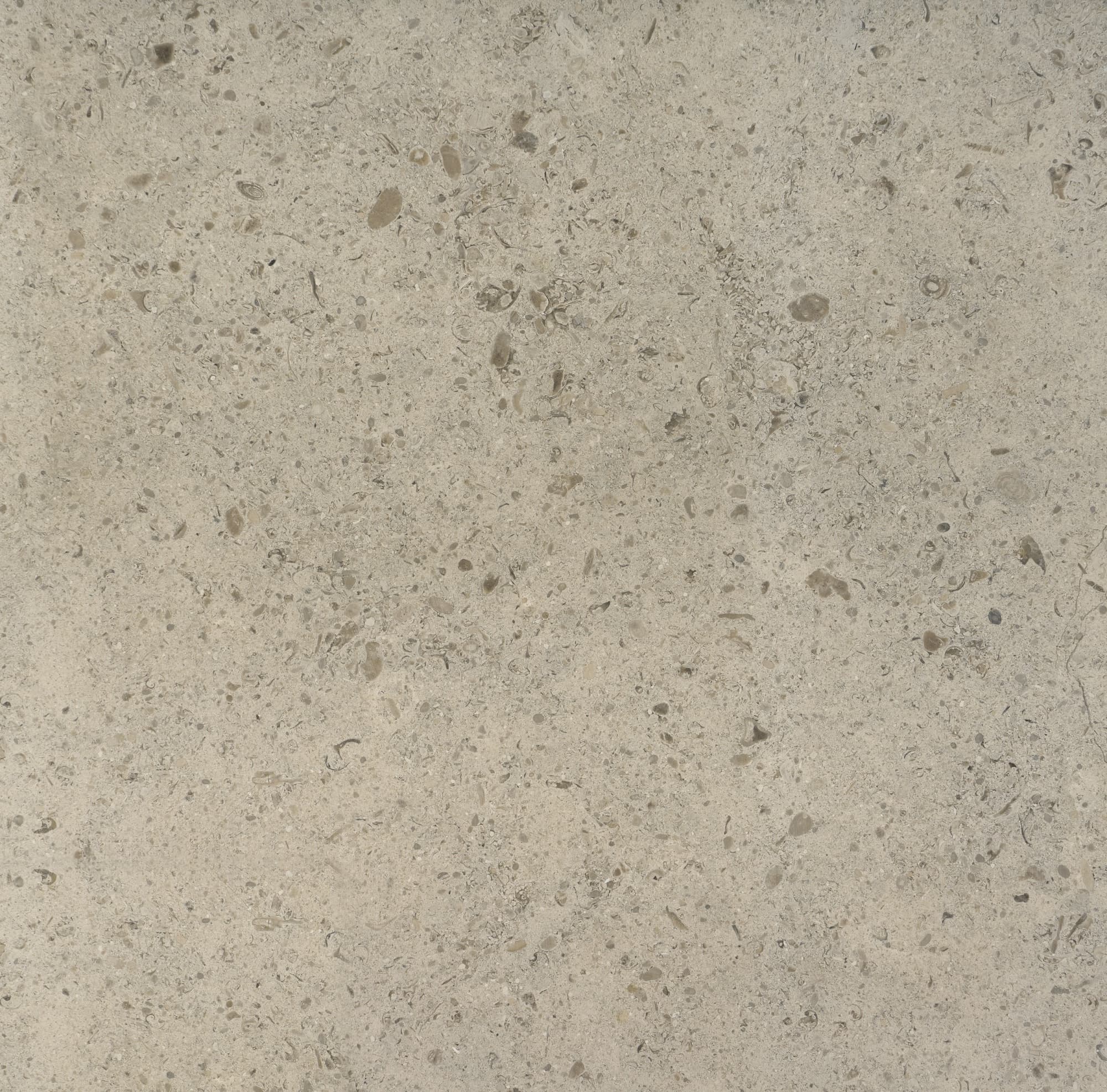
The best-known Portuguese limestone, and for good reason. Moca Creme is a warm, creamy, dense limestone used worldwide for floors, cladding, and facades. Its warmth and consistency make it a safe, elegant default for almost any scheme, and it comes in more than one grain character, from a textured, fossil-flecked Classic to calmer, finer selections. It is the stone to reach for when you want warmth, coherence, and reliability. We cover its variants in depth in our Moca Creme Classic vs Sintra guide.
The Moleanos family
Moleanos is the durable one: a dense, hard, capable limestone that comes in more than one grain and tone, including a distinctive blue-grey Azul. It is the Portuguese limestone to specify when durability and a slightly cooler, more architectural character matter, and it handles heavy traffic and exterior work with the right selection.
The Atlantic family
The Atlantic limestones are a tonal range rather than a single stone: Beige, Grey, White, and Mix, all sharing a dense, even base and differing mainly in colour. This lets an architect compose a whole building in one coherent limestone language while shifting tone from space to space, which is a genuinely useful specification tool.
Ataija Azul
Ataija Azul is the characterful one: a limestone with fossil detail and a cooler, blue-grey cast that gives more visual interest than a plain field. It suits schemes that want texture and story in the stone rather than pure calm.
Between these, most Portuguese limestone briefs are covered: Moca Creme for warm coherence, Moleanos for durability, Atlantic for tonal composition, Ataija for character.
How to choose among them
With the families in view, the choice comes down to a few questions.
Warm or cool? Moca Creme and the warmer Atlantic faces read warm and welcoming; Moleanos Azul, Ataija Azul, and Atlantic Grey read cooler and more contemporary. Tone sets the temperature of the whole space, so decide this first.
Calm or characterful? If you want a quiet, even field, choose the finer, plainer selections. If you want fossil detail and movement, Ataija Azul or the textured Moca Creme Classic give it. Match the stone's busyness to how much the scheme wants the floor or wall to speak.
How hard-working? For very heavy traffic or exterior exposure, lean toward the denser varieties like Moleanos and back the choice with the specific block's test data. For interior floors and walls, the whole family performs well.
One tone or a composed palette? If you want tonal variety across a building without discord, the Atlantic family is built for exactly that. If you want a single warm ground everywhere, Moca Creme is the classic answer.
Then, whichever you choose, apply the same discipline: reserve from a known bed, specify to tested numbers, choose the finish for the application, and seal and maintain with pH-neutral products.
Finish and application
Portuguese limestones take the full finish range, and the finish should track the application, not the other way around.
Honed is the interior default for floors and cladding: smooth, even, wears gracefully.
Brushed and bush-hammered add grip and texture for wet areas, exterior paving, and facades.
Sawn and sandblasted give understated, civic surfaces for traditional and heavy-duty work.
Polished is available but generally off-brief for stones whose appeal is calm warmth; keep it honed or textured.
For the full finish logic, see our honed vs flamed vs brushed guide. For exterior work specifically, the framework in our exterior cladding guide applies directly, and the denser Portuguese limestones are natural candidates for it.
The honest caveats
Portuguese limestone is a workhorse, not a miracle. Two honest points. First, it is calcite-based, so it etches with acid and wants sealing and pH-neutral cleaning, like all limestone. Second, not every Portuguese limestone is dense enough for every application; the softer selections are interior stones, and exterior use in a cold climate needs the specific block's absorption and freeze-thaw figures, not a blanket assumption. Specify to the real numbers and Portuguese limestone rarely disappoints.
Sourcing Portuguese limestone
Because the families vary in tone, grain, and density, Portuguese limestone rewards sampling the specific stone and selection you intend to build, in your intended finish, viewed in the real light of the space. The warm and cool tones shift noticeably between interior light and daylight.
If you are specifying Portuguese limestone for a project, start a project brief and we will match the stone, bed, and finish to your application, with honest guidance on where each belongs. Or request samples of Moca Creme, Moleanos, Atlantic, and Ataija and choose with the real stones in hand.



Notes from the studio
Occasional essays on material, sourcing, and the quiet craft of specifying stone. No noise.